Critical Unbound DNSSEC Flaw Could Enable Remote Code Execution
NLnet Labs patches critical Unbound vulnerability CVE-2026-81642, a CVSS 9.1 DNSSEC validator heap overflow that could cause denial of service or potentially enable remote code execution.
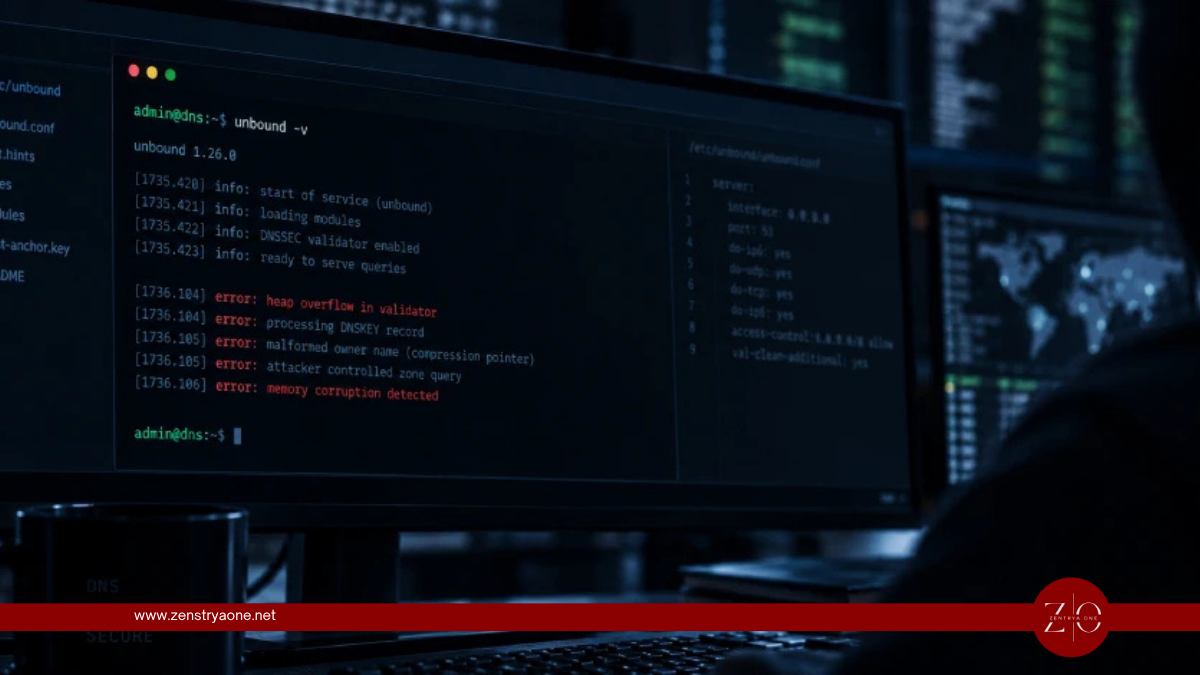
NLnet Labs has released an urgent security update for Unbound, fixing a critical vulnerability in its DNSSEC validator that could allow an attacker controlling a malicious DNS zone to crash a vulnerable resolver and potentially achieve remote code execution (RCE).
Tracked as CVE-2026-81642, the vulnerability affects all Unbound releases up to and including version 1.26.0. It has been assigned a CVSS 4.0 score of 9.1 by NLnet Labs.
CVE-2026-81642 at a Glance
| Detail | Information |
|---|---|
| CVE | CVE-2026-81642 |
| Severity | Critical |
| CVSS 4.0 | 9.1 |
| Vulnerability | Heap-based buffer overflow |
| Component | Unbound DNSSEC validator |
| Authentication | Not required |
| Impact | DoS and possible RCE |
| Affected | Unbound ≤ 1.26.0 |
| Fixed | Unbound 1.26.1 |
| Active Exploitation | None reported |
How the Vulnerability Works
The flaw occurs when Unbound's DNSSEC validator processes a specially crafted DNSKEY record.
According to NLnet Labs, a DNSKEY whose owner name contains a compression pointer referencing its own record data can overflow a digest buffer. Because the overflowing data can be attacker-controlled, the vulnerability can cause a resolver crash and potentially be leveraged for remote code execution.
The attack path can be summarized as:
Attacker controls malicious DNS zone → Query reaches vulnerable Unbound resolver → Malicious DNSKEY processed → Heap buffer overflow → Resolver crash / possible RCE
This is particularly concerning because an attacker does not necessarily need direct administrative access to the DNS resolver. They need to control a malicious zone and cause the vulnerable resolver to query it.
Second RCE-Related Flaw Also Patched
Unbound 1.26.1 fixes eight additional vulnerabilities.
Among them is CVE-2026-82717, a high-severity heap corruption vulnerability affecting CNAME synthesis. NLnet Labs warns that it could also potentially result in arbitrary code execution under certain operating systems and compilation configurations.
Other vulnerabilities addressed in the release involve denial-of-service conditions, excessive resource consumption, DNSSEC behavior and DNS processing.
What Administrators Should Do
Organizations running Unbound should prioritize upgrading to Unbound 1.26.1 or later.
Administrators unable to immediately upgrade can apply the patches provided by NLnet Labs to the source tree. The project provides both individual patches for CVE-2026-81642 and combined patches covering the vulnerabilities addressed in the release.
DNS administrators should also monitor for:
- Unexpected Unbound crashes or restarts
- Abnormal DNSSEC validation failures
- Unusual queries to unfamiliar domains
- Segmentation faults or memory-related errors
- Suspicious behavior from the Unbound process
No Active Exploitation Reported
At the time of disclosure, NLnet Labs had not reported evidence that CVE-2026-81642 was being actively exploited.
However, because the vulnerability is remotely triggerable under the required conditions and potentially allows attacker-controlled data to influence a heap overflow, organizations should not delay patching.
Security Takeaway
CVE-2026-81642 is particularly serious because it affects a core component of DNS infrastructure and can be triggered through a malicious DNS zone without authentication.
The attack scenario is:
Malicious Zone → Crafted DNSKEY → DNSSEC Validation → Heap Overflow → DoS / Potential RCE
Organizations operating Unbound resolvers should upgrade to version 1.26.1 or later as soon as possible.
Related reporting

Warlock Exploits SharePoint Flaws to Disable Security Tools and Deploy Ransomware
Warlock ransomware attackers exploit Microsoft SharePoint vulnerabilities to gain initial access, disable security tools and distribute ransomware across critical infrastructure networks.

Apple CoreGraphics Zero-Day PoC Emerges as WhatsApp PDF Checks Raise Delivery Questions
A public PoC for Apple CoreGraphics CVE-2026-86950 demonstrates memory corruption through a malicious PDF, while new WhatsApp PDF protections raise questions about a possible delivery path.

Kiteworks Fixes Critical Vulnerability Discovered During Emergency Shutdown
Kiteworks patched a previously unknown critical vulnerability discovered during a nine-hour precautionary shutdown prompted by intelligence about a potential cyberattack, with no evidence of exploitation.