Google Play Early Access Abused to Distribute Thousands of Deceptive Android Apps
Cybercriminals are exploiting Google Play's Early Access program to distribute deceptive Android applications, including fake gambling platforms, financial scams, game clones and potentially malicious utilities, while taking advantage of the lack of public ratings and reviews.
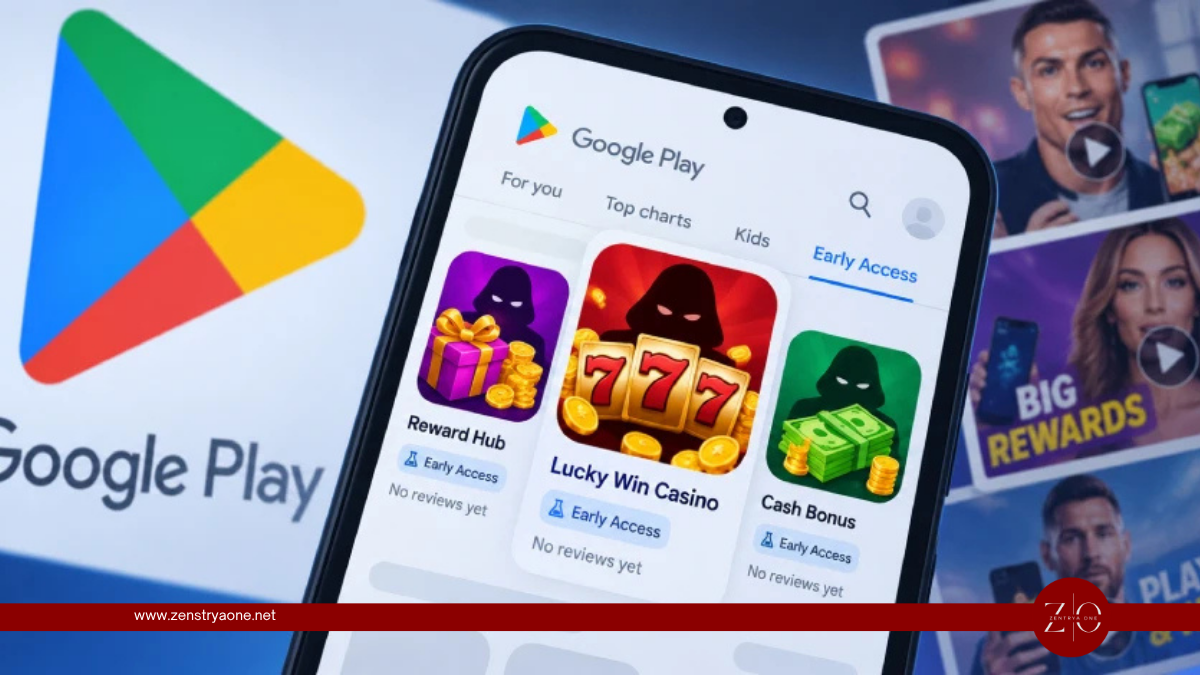
A new investigation has highlighted how Google's Early Access model can be abused by threat actors to make fraudulent applications appear more trustworthy and reach potential victims through legitimate Google Play infrastructure.
According to research from Bitdefender, malicious developers are using Early Access listings alongside paid social-media advertising, fake rewards and AI-generated or deepfake celebrity promotions to convince users to install deceptive applications.
The researchers observed fraudulent applications imitating popular games and services, fake casino platforms promoted through celebrity deepfakes, financial scams and seemingly ordinary utilities such as QR-code scanners and PDF readers. Some of the applications accumulated thousands of downloads before being removed.
The problem is amplified by a key characteristic of Early Access: public ratings and reviews are not available in the same way they are for established Play Store applications. This removes an important source of information users traditionally rely on when deciding whether an unfamiliar application is trustworthy.
Why Google Play Early Access Is Being Abused
Google's Early Access program is designed to allow developers to distribute applications before a full public release. Developers can use the feedback from early users to identify bugs, improve functionality and refine their products.
However, the same characteristics that make Early Access useful for legitimate developers can make it attractive to scammers.
A conventional Play Store listing provides users with several reputation signals, including:
- User ratings
- Public reviews
- Download information
- Developer information
- Application history
- User complaints
Early Access listings can provide considerably less community feedback.
For a legitimate developer, this is simply part of the testing process.
For a malicious developer, it can create an environment where victims have fewer opportunities to identify an application as fraudulent before installation.
Fake Apps Use Social Media to Drive Victims to Google Play
The campaign does not rely exclusively on organic discovery inside Google Play.
Researchers observed malicious developers using advertising platforms such as TikTok and Facebook to promote deceptive applications.
These advertisements can direct users toward an Early Access application, creating a multi-stage trust chain:
Social-media advertisement → Celebrity endorsement or false promise → Google Play listing → App installation → Scam or malicious activity
The use of Google Play as the final destination can make the operation appear more legitimate to users who might otherwise be suspicious of an APK downloaded from an unknown website.
Deepfake Celebrities Used to Promote Fake Casinos
One particularly concerning technique involves fake advertisements featuring recognizable celebrities.
Bitdefender researchers identified advertisements promoting fraudulent gambling applications that used deepfake representations of public figures including Cristiano Ronaldo, Jason Statham and Andrew Tate.
The advertisements are designed to exploit the familiarity and perceived credibility of well-known personalities.
Instead of asking users to download an obviously suspicious APK, the campaigns can direct them toward applications hosted through Google Play's Early Access ecosystem.
This combination of deepfake content, social-media advertising and trusted application infrastructure can significantly increase the effectiveness of the social-engineering campaign.
Game Clones Exploit Popular Releases
Gaming-related applications are another major component of the abuse.
Researchers found applications attempting to capitalize on interest surrounding major game releases, including titles associated with the Grand Theft Auto franchise.
Fraudulent applications can use legitimate screenshots, branding elements and descriptions to make themselves appear associated with anticipated games.
The goal is not necessarily to provide a functioning game.
Instead, attackers can use the popularity of a major title to generate downloads and subsequently expose users to scams, unwanted advertising or malicious functionality.
Financial Scams Add Another Layer
The deceptive applications are not limited to entertainment.
Some listings use financial incentives to encourage users to interact with the application.
For example, fraudulent applications can promise users that they will earn or multiply money by completing tasks or progressing through the application.
These schemes are particularly dangerous because the victim may initially believe that the application provides a legitimate earning opportunity.
Once trust has been established, the operator can attempt to obtain money, personal information or other sensitive data.
Utility Applications Can Also Be Used as Decoys
Bitdefender also identified applications presenting themselves as ordinary utilities.
Examples include:
- QR-code scanners
- PDF readers
- General-purpose utility applications
- Other seemingly useful tools
The simplicity of these applications can make them effective decoys because users may not expect a QR scanner or document reader to be associated with a sophisticated scam operation.
Researchers also observed cases where essentially identical applications appeared under multiple developer identities.
This approach can allow malicious operators to maintain distribution even when one listing is removed.
Removal Does Not Necessarily End the Campaign
One of the challenges highlighted by the research is the speed at which deceptive applications can be replaced.
When Google identifies and removes a malicious listing, the operators can potentially publish another version under a different developer account or application identity.
This creates a cycle:
Publish → Promote → Collect downloads → Detection → Removal → Repackage → Publish again
Some of the fraudulent applications identified by Bitdefender had already accumulated thousands of downloads.
Meanwhile, other suspicious applications remained available through Early Access at the time of the research.
The Trust Problem Created by Missing Reviews
The absence of public reviews creates an important security problem.
Reviews are not a perfect defense against malicious applications. Attackers can manipulate ratings, purchase fake reviews or create applications with convincing descriptions.
Nevertheless, user feedback provides an additional layer of community-based threat intelligence.
A victim who discovers that an application is fraudulent can potentially warn other users through a public review.
When that feedback mechanism is unavailable, subsequent users have fewer signals indicating that an application may be dangerous.
This makes the first wave of victims particularly important for identifying emerging scams.
Attackers Are Combining Multiple Trust Signals
The campaign demonstrates how modern app scams can combine several independent trust mechanisms.
| Attack technique | Purpose |
|---|---|
| Google Play listing | Makes the application appear legitimate |
| Early Access status | Reduces public reputation signals |
| Social-media advertising | Provides large-scale victim acquisition |
| Deepfake celebrities | Creates false credibility |
| Fake rewards | Encourages downloads and engagement |
| Popular game branding | Exploits existing user interest |
| Multiple developer accounts | Makes repeated distribution easier |
| Utility applications | Provides seemingly legitimate reasons to install |
Individually, none of these techniques is particularly new.
The danger comes from combining them into a single distribution strategy.
Why the Campaign Matters
The findings highlight an important change in the Android threat landscape.
Users are increasingly being targeted through legitimate distribution channels rather than obviously malicious websites.
The presence of an application on Google Play can create an assumption that the application has been thoroughly verified and is safe.
However, application-store presence should not be treated as an absolute guarantee of legitimacy.
Attackers can exploit gaps between automated security screening, developer-account controls, user reporting and application review processes.
Security Recommendations for Android Users
Users should take additional precautions when installing applications from Early Access or unfamiliar developers.
Check the Developer
Examine the developer's identity and other applications before installing an unfamiliar app.
A newly created developer account with little history deserves additional scrutiny.
Be Suspicious of Unrealistic Rewards
Applications promising unusually high financial returns, guaranteed winnings or large rewards should be treated cautiously.
Legitimate applications generally do not need extraordinary financial promises to convince users to install them.
Do Not Trust Celebrity Promotions Automatically
A celebrity appearing in a video advertisement does not prove that the person actually endorsed the application.
Deepfake technology makes fabricated endorsements increasingly convincing.
Verify Game Releases Through Official Sources
Users looking for unreleased or highly anticipated games should verify availability through the publisher's official website or established distribution channels.
Review Requested Permissions
A simple utility application requesting access to sensitive device functions should raise suspicion.
Users should consider whether the permissions requested are actually necessary for the application's advertised purpose.
Keep Android Updated
Security updates can reduce the impact of vulnerabilities that malicious applications attempt to exploit.
Users should also keep Google Play services and installed applications updated.
Organizations Should Address Mobile-App Risk
The issue is not limited to individual consumers.
Organizations allowing employees to use personal Android devices for business purposes should consider the risks posed by deceptive applications.
Mobile security policies can include:
- Mobile application management
- Mobile threat defense
- Application allowlisting for sensitive environments
- Restrictions on unknown applications
- Security awareness training
- Phishing and social-engineering awareness
- Conditional access controls
- Device-integrity checks
- Monitoring for compromised devices
Organizations should also educate employees that an application being available through an official marketplace does not automatically mean it is trustworthy.
A New Challenge for App-Store Security
The abuse of Early Access highlights a difficult balance for Google.
Early-access programs can help legitimate developers test products and obtain feedback before a wider release.
At the same time, reduced community feedback can remove one of the mechanisms that helps users identify fraudulent applications.
The challenge is therefore not simply about removing individual malicious applications.
It is about preventing attackers from repeatedly exploiting the same distribution model after each malicious listing is taken down.
Conclusion
The abuse of Google Play's Early Access ecosystem demonstrates how scammers can combine legitimate application infrastructure with social engineering, deepfake advertising and deceptive application content.
Bitdefender's findings show that the activity extends across fake casinos, financial scams, game clones and ordinary-looking utilities, with some applications receiving thousands of downloads before detection.
The absence of public ratings and reviews makes it harder for users to independently assess unfamiliar Early Access applications, while social-media campaigns can direct large numbers of potential victims toward the listings.
For Android users, the key lesson is simple: an application being available through Google Play should not eliminate the need for scrutiny.
Users should verify developers, question unrealistic promises, avoid suspicious advertisements and carefully review application permissions before installation. For Google and the wider Android ecosystem, the campaign highlights the need for stronger safeguards around early-access applications and faster mechanisms for detecting repeat malicious developers.
Related reporting
Attackers Use Passkey-Themed Phishing to Hijack Microsoft Cloud Accounts and Steal Data
Threat actors are using passkey-themed social engineering to compromise Microsoft 365 accounts and gain access to sensitive cloud data, according to Microsoft Threat Intelligence.

Anthropic Says Seven China-Based AI Labs Ran Industrial-Scale Claude Distillation Attacks
Anthropic says it identified and disrupted seven industrial-scale attempts to extract capabilities from its Claude AI models, attributing the activity to China-based AI laboratories.
Claude Used to Automate Exploitation and Data Theft Across Multiple Victims
Cybercriminals and state-sponsored threat actors are increasingly using artificial intelligence to automate portions of real-world cyberattacks, with Anthropic revealing that its Claude models were incorporated into multi-stage operations involving reconnaissance, exploitation, credential theft and data exfiltration.