Hackers Exploit Critical Cisco Firewall Vulnerability to Gain Root Access and Deploy Malware
Threat actors are actively exploiting a critical vulnerability in Cisco firewall software to obtain elevated privileges and deploy malicious payloads, highlighting the growing risk posed by compromised internet-facing security appliances.
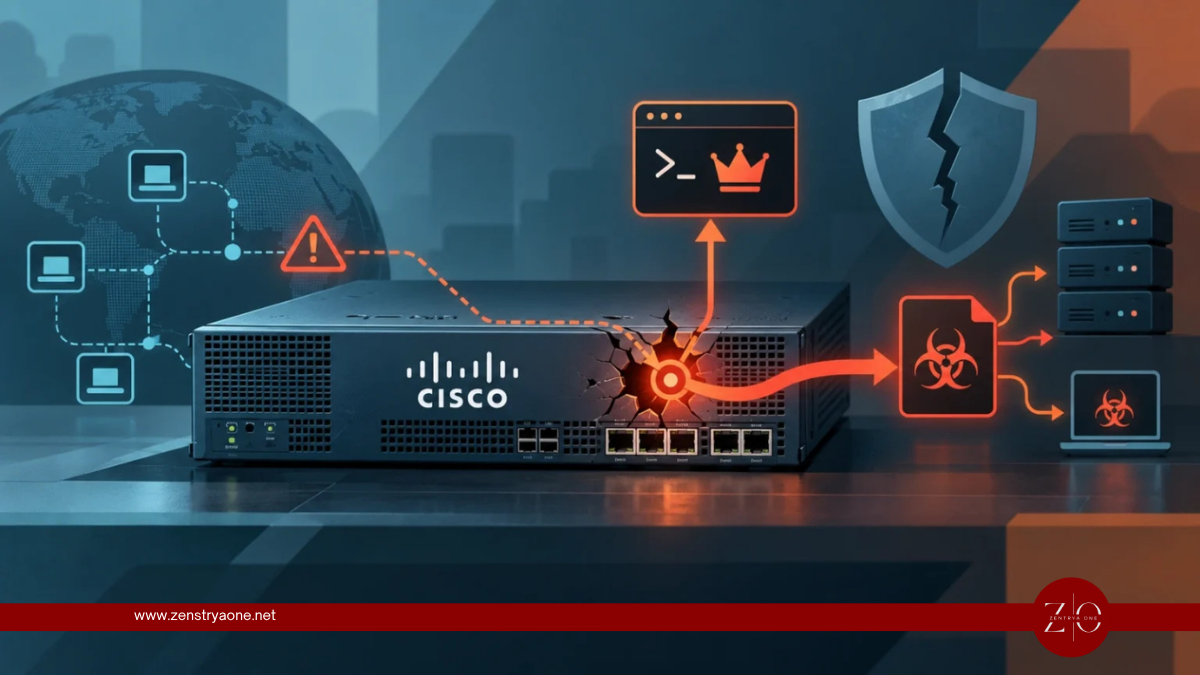
Cisco firewall infrastructure has once again become a target for attackers seeking direct access to enterprise networks. A successful compromise of a firewall can provide adversaries with a highly privileged position at the edge of an organization, potentially allowing them to intercept traffic, modify security policies, establish persistence and move deeper into internal environments.
The latest activity underscores why vulnerabilities affecting network security appliances require a different level of urgency than flaws in ordinary endpoints. Once attackers gain control of a firewall, traditional endpoint defenses may have limited visibility into the compromise.
Critical Vulnerability Enables High-Privilege Access
The targeted Cisco security flaw affects Cisco firewall technology used to provide VPN connectivity and perimeter security.
Cisco's firewall products have previously been targeted through vulnerabilities that expose remotely accessible services. One notable example is CVE-2025-20333, a critical vulnerability in the VPN web server functionality of Cisco Secure Firewall Adaptive Security Appliance (ASA) and Secure Firewall Threat Defense (FTD) software.
The vulnerability can allow an unauthenticated remote attacker to execute arbitrary code on an affected device. Successful exploitation can ultimately provide the attacker with highly privileged access to the underlying firewall operating system.
The vulnerability was among a pair of Cisco ASA/FTD flaws that came under active exploitation and prompted urgent warnings from security authorities.
Why Firewall Compromise Is So Dangerous
A firewall is one of the most strategically valuable systems inside an enterprise.
Unlike a compromised workstation, a compromised firewall can provide an attacker with visibility into traffic entering and leaving the organization.
Depending on the device and the attacker's level of access, a compromised firewall could potentially be used to:
- Modify firewall and access-control policies
- Monitor network traffic
- Manipulate VPN configurations
- Create unauthorized administrative access
- Redirect network connections
- Disable or weaken security controls
- Capture authentication information
- Establish persistent access
- Launch attacks against internal systems
- Deploy additional malware
Attackers therefore have a strong incentive to target vulnerabilities that provide direct access to network appliances.
From Initial Exploitation to Malware Deployment
The observed attack pattern follows a familiar progression.
Internet-facing firewall → Vulnerability exploitation → Privilege escalation → Persistence → Malware deployment → Internal reconnaissance
After gaining access, attackers can use the firewall as a launch point for additional activity.
Rather than immediately deploying a noisy payload, an adversary may first inspect the compromised system, identify available interfaces and configurations, determine what internal networks are accessible and search for credentials or other information that can support further intrusion.
This makes post-exploitation monitoring particularly important.
Root-Level Access Raises the Stakes
Obtaining root-level or equivalent privileged access significantly increases the impact of a firewall compromise.
At this level, attackers may be able to interact with sensitive system components that are normally protected from ordinary users.
The attacker can potentially modify configuration files, manipulate running services, install additional components and attempt to maintain access even after the original vulnerability is patched.
Cisco firewall compromises have historically demonstrated how attackers can use privileged access to introduce persistent malicious components. Researchers have previously documented attacks involving Cisco networking equipment in which firmware-level or privileged compromise was used to maintain access and support malicious activity.
Malware Deployment Can Turn a Firewall Into a Long-Term Foothold
Once a security appliance has been compromised, malware can be used to transform a temporary vulnerability exploit into persistent access.
Potential objectives include:
- Maintaining remote access after reboot
- Monitoring network activity
- Collecting credentials
- Downloading additional payloads
- Executing commands remotely
- Pivoting toward internal systems
- Disabling or bypassing security controls
This is particularly concerning because many organizations do not monitor firewalls with the same depth applied to Windows, Linux and endpoint systems.
A compromised firewall can therefore remain undetected for considerably longer.
Organizations Should Not Assume Patching Ends the Incident
One of the most important lessons from attacks against network appliances is that patching a vulnerable device does not automatically remove an existing compromise.
If attackers successfully exploited the vulnerability before the security update was installed, administrators should treat the device as potentially compromised.
Security teams should therefore consider:
- Reviewing administrative login activity
- Examining configuration changes
- Checking for newly created accounts
- Reviewing VPN configuration changes
- Investigating unexpected outbound connections
- Examining running processes and services
- Looking for unauthorized files or scripts
- Comparing configurations against known-good backups
- Reviewing firewall and VPN logs for suspicious activity
- Investigating connected systems for lateral movement
For highly sensitive environments, rebuilding or restoring the appliance from a trusted image may be preferable to assuming that a software update completely removes attacker access.
Monitor VPN and Firewall Activity
Because Cisco firewall vulnerabilities frequently involve remotely accessible VPN or web-management functionality, organizations should pay particular attention to unusual activity around these services.
Potential warning signs include:
- Repeated connection attempts from unfamiliar IP addresses
- Unexpected VPN sessions
- Administrative access outside normal operating hours
- Configuration changes that were not approved
- New VPN users or certificates
- Unexpected policy modifications
- Unusual outbound connections from the appliance
- Repeated authentication failures followed by successful access
- Unexpected system reloads or service restarts
These indicators should be correlated with SIEM, network and endpoint telemetry wherever possible.
Why Security Appliances Are Attractive Targets
The growing focus on firewalls, VPN gateways and edge appliances reflects their strategic position within enterprise networks.
A single vulnerability can potentially give an attacker access to an asset that:
- Sits directly on the internet.
- Processes untrusted traffic.
- Controls access to internal networks.
- Handles VPN connections.
- Contains sensitive network configuration.
- May operate with extensive system privileges.
This combination makes network appliances particularly valuable targets for both financially motivated attackers and advanced threat groups.
Recommended Security Actions
Organizations running affected Cisco firewall products should prioritize the following actions:
Apply Cisco's security updates
Ensure that affected firewall and VPN appliances are running a Cisco-recommended fixed release.
Restrict management exposure
Administrative interfaces should not be unnecessarily exposed to the public internet. Where possible, management access should be restricted through dedicated management networks, VPNs or access-control lists.
Review previously exposed devices
If an affected firewall was publicly accessible while vulnerable, investigate it for signs of compromise even after applying the patch.
Audit privileged accounts
Review local and centralized administrator accounts for unexpected additions, changes or authentication activity.
Inspect VPN configuration
Look for unauthorized VPN users, certificates, profiles, authentication changes and policy modifications.
Monitor network traffic
Unexpected connections originating from a firewall itself should receive particular attention.
Rebuild when compromise is confirmed
If evidence of malware or unauthorized persistence is found, organizations should follow their incident-response procedures and consider restoring the appliance from a trusted state.
The Broader Security Lesson
The exploitation of critical firewall vulnerabilities demonstrates why perimeter security devices cannot be treated as ordinary infrastructure.
Firewalls are security controls, but they are also high-value operating systems and applications that process potentially hostile input every day.
When vulnerabilities allow attackers to bypass authentication or execute code remotely, the security boundary itself can become the attacker's foothold.
Recent Cisco disclosures also demonstrate that critical vulnerabilities can affect different layers of the company's networking portfolio. In September 2026, Cisco disclosed additional critical IOS XR vulnerabilities, including CVE-2026-20274 and CVE-2026-20279, both rated CVSS 9.8, reinforcing the need for continuous patching across network infrastructure.
Conclusion
The exploitation of a critical Cisco firewall vulnerability to obtain privileged access and deploy malware highlights the serious consequences of compromising internet-facing security infrastructure.
For defenders, the priority should go beyond simply installing a patch. Organizations must determine whether vulnerable devices were exploited before remediation and investigate potential persistence, unauthorized configuration changes and subsequent activity across connected networks.
A compromised firewall is not simply another compromised device—it can become an attacker-controlled gateway into the organization itself.
Security teams should therefore treat exposed Cisco firewall vulnerabilities as high-priority incidents, combine rapid patching with threat hunting, and maintain continuous monitoring of VPN, administrative and network-edge activity.
Related reporting

Hackers Exploit Critical WSO2 API Manager JWT Flaw Using Forged Admin Tokens
Security researchers have detected active exploitation attempts targeting a critical authentication-bypass vulnerability in WSO2 API Manager, with attackers sending forged JSON Web Tokens (JWTs) containing administrator privileges.

Nintendo Switch Vulnerability Lets Nearby Attackers Run Unauthorized Code via QR Code Feature
Nintendo has patched a high-severity vulnerability in the original Nintendo Switch that could allow a nearby attacker to execute unauthorized code or access information stored on the console.

China-Linked Hackers Chain Chrome and Windows Zero-Days to Deploy GRIMWEDGE Backdoor
China-linked threat actors have been observed chaining multiple vulnerabilities in Google Chrome and Microsoft Windows as part of sophisticated cyber-espionage campaigns targeting non-governmental organizations and other high-value organizations.