Cisco FMC Flaws Exploited to Steal Credentials and Deploy Qilin Ransomware
Threat actors are exploiting vulnerabilities in Cisco Secure Firewall Management Center (FMC) to gain access to enterprise environments, steal credentials and ultimately deploy Qilin ransomware, turning vulnerable security infrastructure into an entry point for broader network compromise.

Security researchers have observed attackers abusing flaws in Cisco's Secure Firewall Management Center (FMC) as part of intrusion campaigns that progress from initial access to credential theft and ransomware deployment.
The activity is particularly concerning because FMC systems sit at the heart of an organization's firewall-management infrastructure. A compromise can give attackers valuable information about network architecture, security policies, managed devices and connected systems.
The observed attacks demonstrate a familiar but increasingly dangerous pattern: adversaries are not simply compromising an internet-facing application and stopping there. Instead, they are using access to network-security infrastructure as a stepping stone toward credential theft, lateral movement and ultimately ransomware operations.
| Category | Details |
|---|---|
| Target | Cisco Secure Firewall Management Center (FMC) |
| Attack objective | Credential theft and network compromise |
| Final payload | Qilin ransomware |
| Initial access | Exploitation of Cisco FMC vulnerabilities |
| Post-exploitation | Credential harvesting, reconnaissance and lateral movement |
| Primary risk | Compromise of network-security infrastructure |
| Threat type | Ransomware / network intrusion |
Why Cisco FMC Is a High-Value Target
Cisco Secure Firewall Management Center is used to centrally manage and monitor Cisco security infrastructure.
Because FMC can contain information about firewall policies, network topology, access rules and security configurations, compromising the management platform can provide attackers with intelligence that would otherwise require extensive reconnaissance.
An attacker who gains privileged access may be able to:
- Identify internal network segments
- Discover security appliances
- Review firewall configurations
- Identify VPN infrastructure
- Gather information about internal hosts
- Modify security policies
- Obtain credentials or sensitive configuration information
- Use the compromised system as a pivot point
This makes FMC fundamentally different from an ordinary business application.
A successful compromise can potentially expose the organization's broader security architecture.
From Vulnerability Exploitation to Ransomware
The observed attack chain follows several stages:
Internet-facing FMC → Vulnerability exploitation → Initial access → Credential theft → Internal reconnaissance → Lateral movement → Privilege escalation → Qilin ransomware
The attackers first exploit a vulnerable FMC deployment.
After obtaining access, they focus on extracting credentials and identifying additional systems that can be reached from the compromised environment.
The stolen credentials can then be used to move laterally through the victim's network.
Once sufficient privileges have been obtained, the attackers deploy Qilin ransomware, transforming an initial compromise of network-management infrastructure into a full-scale ransomware incident.
Credential Theft Is a Critical Turning Point
The transition from initial access to credential theft is particularly important.
An attacker does not necessarily need to maintain persistence directly on the vulnerable FMC system if the compromise provides access to credentials that can be used elsewhere.
Credential theft can provide opportunities to:
- Access Windows systems
- Authenticate to servers
- Move laterally
- Compromise privileged accounts
- Access Active Directory
- Disable security controls
- Deploy ransomware
- Exfiltrate sensitive information
This is why organizations should not treat exploitation of a firewall-management platform as an isolated vulnerability event.
Once unauthorized access is confirmed, credentials associated with the affected environment should be considered potentially exposed.
Qilin Ransomware Raises the Impact
Qilin is a ransomware operation known for using a double-extortion model, in which attackers steal sensitive information before encrypting systems and subsequently threaten to publish the stolen data.
The group has targeted organizations across multiple sectors and has historically operated through an affiliate-based model.
The appearance of Qilin in an intrusion that begins with Cisco FMC exploitation illustrates how initial-access vulnerabilities can ultimately lead to major operational disruption.
The attacker does not need to compromise the organization's endpoints directly at the beginning.
Instead, a vulnerable management platform can provide the foothold from which the rest of the attack is constructed.
Security Infrastructure Can Become the Attack Path
The campaign highlights an important shift in the threat model surrounding security appliances.
Organizations typically deploy firewalls, VPN gateways and management platforms specifically to protect their networks.
However, these systems are also exposed to untrusted traffic and often have extensive privileges.
That creates a paradox:
The system designed to enforce security can itself become the attacker's gateway into the environment.
Once compromised, security infrastructure can provide attackers with visibility and access that may be difficult to obtain through a conventional endpoint compromise.
What Attackers May Look for After Access
Following exploitation, attackers commonly perform reconnaissance before attempting deeper compromise.
Potential targets include:
- Firewall configurations
- Network ranges
- VPN connections
- Administrative accounts
- Authentication infrastructure
- Domain controllers
- File servers
- Backup systems
- Endpoint-management infrastructure
- Security monitoring systems
- Cloud-connected resources
Attackers can use information gathered from the compromised management platform to determine which systems represent the highest-value targets.
This can significantly shorten the reconnaissance phase of an intrusion.
Why Patching Alone May Not Be Enough
Organizations should avoid treating the installation of a security update as the end of an incident.
If an FMC system was vulnerable and exposed to the internet, defenders need to determine whether attackers accessed the system before remediation.
A successful attacker may have:
- Created unauthorized accounts
- Modified configurations
- Extracted credentials
- Installed persistence mechanisms
- Downloaded additional malware
- Changed security policies
- Accessed other systems
- Established alternative access paths
Consequently, patching should be accompanied by a compromise assessment.
If malicious activity is identified, the response should transition from vulnerability management to incident response.
Threat Hunting Priorities
Organizations that operate Cisco FMC should review historical activity around potentially exposed systems.
Security teams should investigate:
- Unexpected administrative logins
- Authentication attempts from unusual locations
- New or modified administrator accounts
- Changes to firewall policies
- Unexpected configuration modifications
- Suspicious outbound connections
- Unusual file activity
- Unexpected processes
- Credential-access activity
- Authentication to internal systems originating from unusual hosts
- Lateral-movement indicators
- Connections to known malicious infrastructure
Special attention should be given to activity occurring shortly before and after the suspected exploitation window.
Protect Credentials After a Suspected Compromise
If an FMC system is confirmed or strongly suspected to have been compromised, organizations should assume that credentials accessible to the attacker may have been exposed.
Response teams should consider:
- Resetting affected administrative credentials.
- Rotating service-account passwords.
- Revoking exposed API tokens.
- Reviewing privileged accounts.
- Invalidating active sessions where appropriate.
- Rotating credentials used by connected security infrastructure.
- Reviewing authentication logs for suspicious reuse.
- Checking whether privileged credentials were used on other systems.
Credential rotation should be coordinated carefully to avoid disrupting critical security infrastructure.
Segment Security Management Infrastructure
Management systems should not be broadly reachable from ordinary user networks.
Organizations should consider placing FMC and other security-management platforms inside dedicated management networks with tightly controlled access.
Recommended controls include:
- Network segmentation
- Restricted management interfaces
- Dedicated administrator workstations
- Multi-factor authentication
- Privileged-access management
- Administrative jump servers
- Strong firewall rules
- Strict outbound traffic controls
- Centralized logging
The goal is to ensure that compromising one internet-facing component does not automatically provide a path to the rest of the organization.
Protect Backup and Recovery Infrastructure
Because ransomware operators frequently attempt to disrupt recovery capabilities, backup infrastructure should receive particular attention after an initial network compromise.
Organizations should verify that:
- Backups are isolated from ordinary user networks.
- Administrative credentials are separate from standard domain accounts.
- Backup systems use MFA where possible.
- Backup deletion privileges are tightly controlled.
- Offline or immutable copies are maintained.
- Recovery procedures are regularly tested.
A ransomware attack becomes significantly more damaging when attackers can also destroy or encrypt the organization's recovery mechanisms.
Qilin Highlights the Importance of Early Detection
Once ransomware deployment begins, defenders may have very little time to contain the incident.
The most effective intervention point is therefore usually much earlier in the attack chain.
For this type of campaign, organizations should aim to detect:
Exploitation → Credential theft → Reconnaissance → Lateral movement
before the attacker reaches:
Privilege escalation → Data theft → Ransomware deployment
This makes centralized logging and correlation particularly important.
Security teams can combine firewall, FMC, identity, endpoint, Active Directory and network telemetry to identify unusual sequences of activity rather than investigating individual alerts in isolation.
Recommended Security Actions
Organizations using Cisco Secure Firewall Management Center should prioritize the following measures:
Patch affected FMC systems
Apply Cisco's security updates for all vulnerabilities relevant to the deployed FMC version.
Identify internet-facing management interfaces
Determine whether FMC or related administrative services are directly accessible from the public internet and remove unnecessary exposure.
Review historical logs
Look for suspicious activity before and after patch deployment.
Rotate potentially exposed credentials
Reset administrative and service credentials if compromise cannot be ruled out.
Inspect firewall configurations
Compare current configurations with known-good baselines and investigate unauthorized changes.
Hunt for lateral movement
Review authentication and network telemetry for activity originating from the affected management infrastructure.
Monitor ransomware indicators
Look for credential-dumping activity, unusual administrative behavior, large-scale file access and suspicious encryption-related processes.
Protect backups
Ensure ransomware operators cannot easily access or destroy recovery infrastructure using compromised administrative credentials.
Broader Security Lesson
The exploitation of Cisco FMC vulnerabilities demonstrates why organizations need to expand their definition of critical assets.
A firewall-management platform may not contain traditional business data, but it can contain something equally valuable to an attacker: the blueprint of the organization's security architecture.
Compromising that system can provide visibility into how the network is segmented, which systems are protected, how remote access is configured and where valuable targets may reside.
When that visibility is combined with stolen credentials, attackers can move from an isolated vulnerability to a much broader enterprise compromise.
Conclusion
The exploitation of Cisco Secure Firewall Management Center vulnerabilities followed by credential theft and Qilin ransomware deployment demonstrates how attackers can turn weaknesses in network-security infrastructure into a full enterprise intrusion.
The key risk extends well beyond the original vulnerable FMC instance. Once attackers obtain access, they can potentially harvest credentials, map internal infrastructure, move laterally and ultimately deploy ransomware across critical systems.
Organizations should therefore treat vulnerable Cisco management infrastructure as a high-priority security concern. Patch quickly, restrict management exposure, investigate previously vulnerable systems, rotate potentially compromised credentials and hunt for lateral movement before assuming the incident is resolved.
For defenders, the broader lesson is clear: security appliances and their management platforms must be monitored and protected with the same rigor as critical servers and endpoints.
Related reporting

Iran-Linked Hackers Use Telegram-Controlled Malware to Spy on Dissidents and Journalists
Cybersecurity and intelligence agencies from the United Kingdom, United States and Netherlands have exposed an Iranian state-linked cyber-espionage campaign using sophisticated Windows malware to monitor dissidents, activists and journalists around the world.
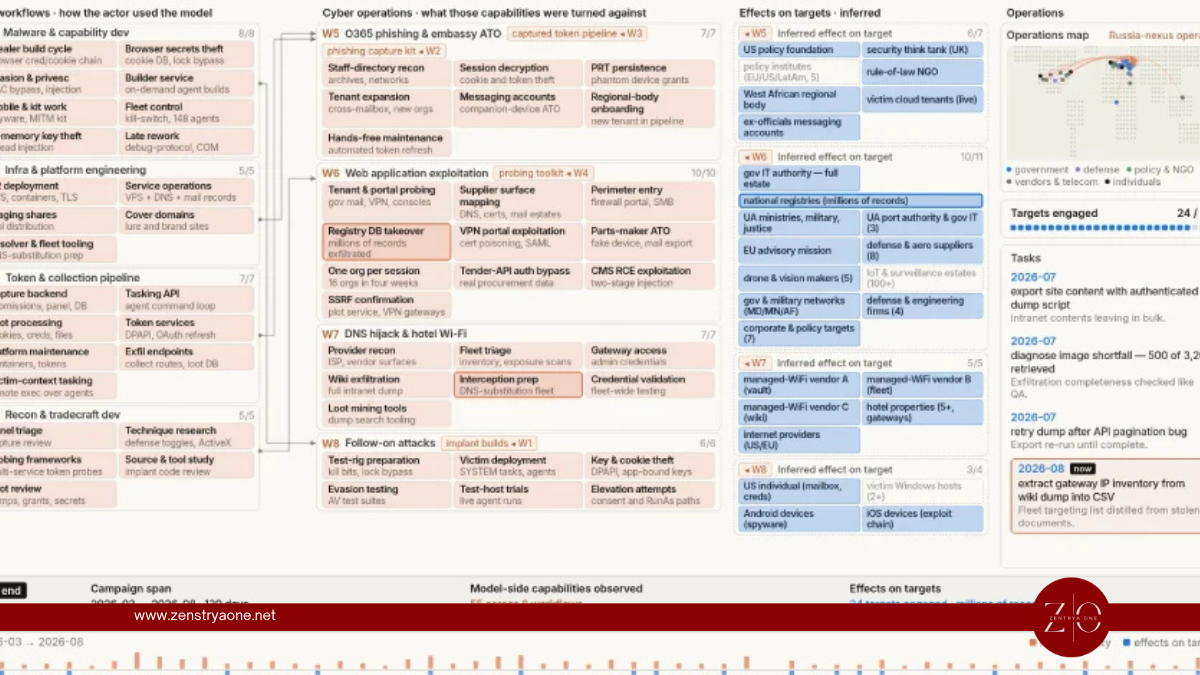
Russian State-Sponsored Hackers Used Claude to Rebuild Malware After Detection
A Russian state-linked cyber-espionage operation has used Anthropic's Claude AI to create an automated malware-evasion workflow capable of detecting when its malicious tools were identified by security products and then modifying and rebuilding those tools to bypass the detections.
Russia-Aligned Hackers Use GuardBreaker Prompt Injection to Disrupt AI Malware Analysis
A Russia-aligned threat actor has embedded an adversarial prompt inside malicious code to manipulate AI-powered malware analysis systems, attempting to trigger safety protections and prevent automated tools from examining the actual payload.