Global Microsoft Outage Disrupts Outlook, Teams and Microsoft 365 Services Worldwide
Global Microsoft outage disrupts Outlook, Teams, Microsoft 365 and Copilot worldwide, affecting businesses, governments and millions of users.
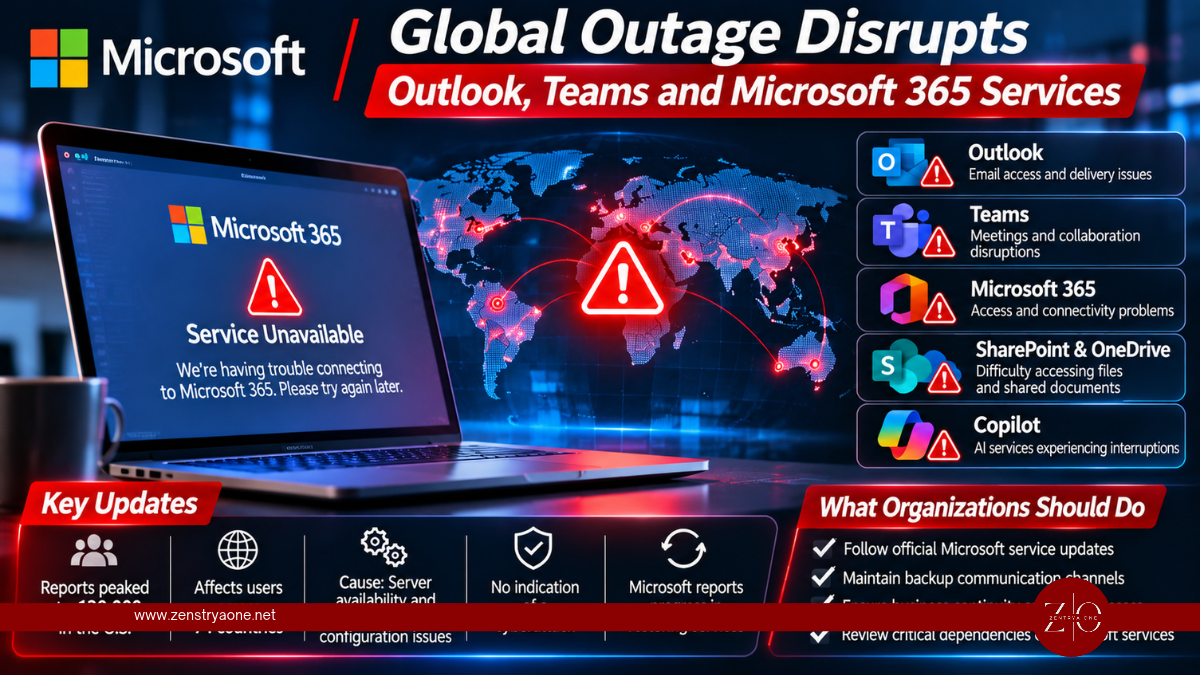
A major Microsoft service outage has disrupted businesses, government agencies, educational institutions and millions of users worldwide, leaving many unable to access essential applications such as Outlook, Microsoft Teams and Microsoft 365.
The disruption began on November 12, 2026, and continued into November 13, affecting users across the Americas, Europe, Asia and Australia.
Microsoft confirmed that it was investigating widespread connectivity failures and working to restore affected infrastructure.
What Microsoft Services Were Affected?
The outage affected several widely used Microsoft cloud services, including:
- Microsoft Outlook: Users experienced difficulties sending, receiving and accessing emails.
- Microsoft Teams: Some users were unable to access meetings and collaboration features.
- Microsoft 365: Applications and services dependent on affected cloud infrastructure experienced connectivity problems.
- Microsoft SharePoint and OneDrive: Some users reported difficulties accessing shared documents and files.
- Microsoft Copilot: AI-powered services experienced interruptions.
According to outage monitoring platform Downdetector, reports peaked at approximately 130,000 in the United States, with disruptions reported across 74 countries and territories.
These figures represent user-submitted outage reports rather than the total number of affected customers.
What Caused the Microsoft Outage?
Microsoft's investigation identified problems involving server availability and automated infrastructure health checks.
A number of servers unexpectedly became unavailable, increasing the workload on the remaining infrastructure and causing widespread connectivity failures.
Microsoft temporarily paused deployments, redirected traffic and restarted affected servers.
The company also tested configuration changes to stabilize the environment and restore services.
Although some recovery attempts initially produced limited results, Microsoft later reported improvements in server stability after applying an authentication and routing configuration patch.
Microsoft stated that there was no indication the outage resulted from a cyberattack or malicious activity.
The complete root cause remains subject to Microsoft's post-incident investigation.
Businesses and Government Services Disrupted
The outage caused significant operational difficulties across multiple industries.
In the United States, businesses experienced email and communication interruptions, while some employees were unable to perform routine work.
Australian organizations reported difficulties accessing business applications, issuing invoices and conducting online classes.
Government agencies and courts in several countries also experienced communication disruptions.
The incident affected integrations relying on Microsoft services, including some connectors used by AI platforms such as OpenAI and Anthropic.
These disruptions demonstrate how failures involving a major cloud provider can affect numerous organizations simultaneously.
Microsoft Reports Progress in Recovery
On November 13, Microsoft reported positive results from infrastructure recovery efforts.
The company said an upstream authentication and routing configuration patch had improved stability on some affected servers.
However, recovery remained uneven, and Microsoft continued monitoring systems while expanding corrective measures.
At the time of reporting, Microsoft had not confirmed that every affected service had been fully restored.
What Organizations Can Learn From This Incident
The outage highlights the importance of business continuity planning and reducing dependence on a single cloud service provider.
Organizations should consider the following measures:
- Maintain alternative communication channels: Establish backup email, messaging and emergency contact methods.
- Develop business continuity plans: Identify essential operations that must continue during cloud outages.
- Prepare offline access: Ensure critical documents and operational information remain available when cloud services fail.
- Monitor service health: Track official Microsoft service advisories and incident notifications.
- Review third-party dependencies: Understand which business applications rely on Microsoft cloud infrastructure.
- Test recovery procedures: Regularly conduct simulations involving cloud service unavailability.
Security Takeaway
The global Microsoft outage demonstrates that major technology disruptions do not always result from cyberattacks.
Infrastructure failures, configuration problems and service dependencies can also create widespread operational consequences.
Organizations should strengthen their cyber resilience and business continuity capabilities to maintain essential operations during unexpected cloud service disruptions.
Related reporting

Italy Fines Meta €805 Million Over Facebook's Unauthorized Access to Android Photo Galleries
Italy fines Meta €805 million for Facebook's Android photo gallery access without specific consent, affecting approximately 20 million users.

SilentAir Hackers Compromise Asian Telecom Networks to Intercept SMS Verification Codes
SilentAir hackers compromise Asian telecom networks to intercept SMS 2FA codes and spy on Taiwanese users, exposing mobile signaling security risks.

Sri Lanka Restricts Two EY Audit Partners Following Rs. 13.64 Billion NDB Bank Fraud
Sri Lanka's Central Bank restricts two EY audit partners following the Rs. 13.64 billion NDB fraud, raising concerns about banking controls and audit oversight.