📸 THE 80s PHOTO TREND: WHAT HAPPENS TO THE PICTURES YOU UPLOAD TO AI?
For many users, it is simply another fun social media trend.
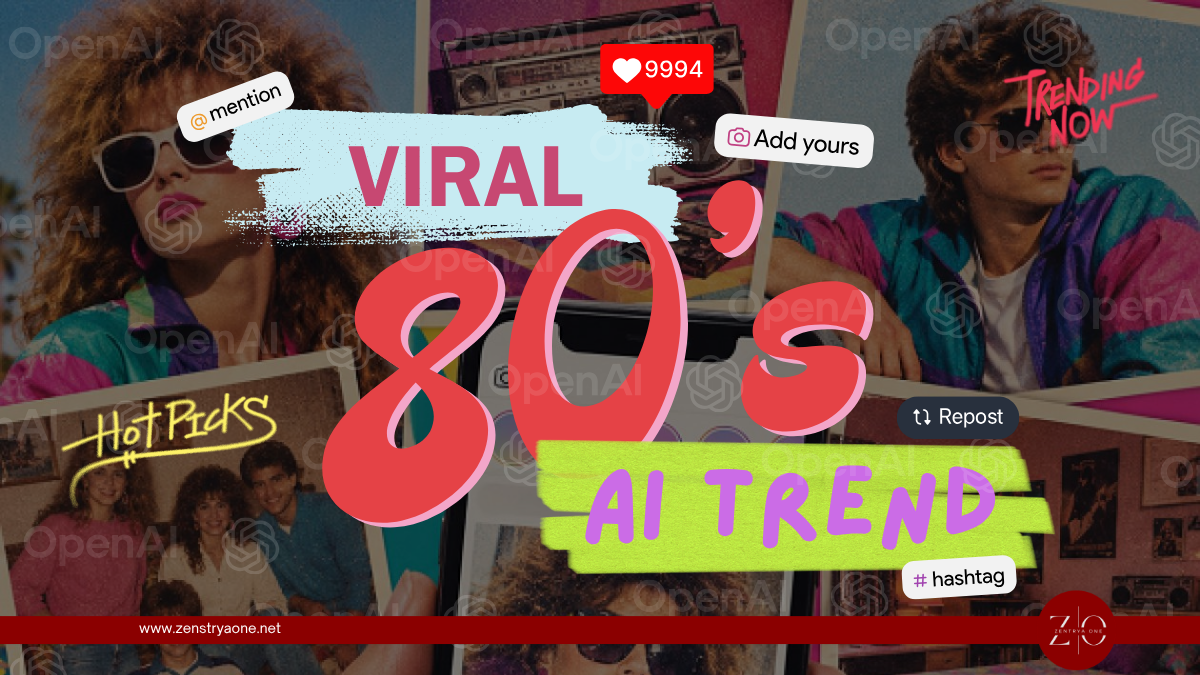
AI & PRIVACY — 01
Over the past few weeks, social media has been filled with photographs that appear to have travelled back several decades. People are transforming their modern photographs into retro-style portraits, recreating the look of the 1980s, experimenting with vintage fashion and creating images that look as though they were taken decades ago.
For many users, it is simply another fun social media trend.
Upload a photograph. Enter a prompt. Wait a few seconds.
And suddenly, you have an AI-generated version of yourself from another era.
But behind the entertainment is a question that is worth asking:
What happens to the original photograph after you upload it to an AI platform?
The concern is not necessarily about the retro image that appears on your screen. The bigger question is about the original photograph, the information contained within it, and how that information may be processed by the platform.
🤖 IT'S MORE THAN JUST A PHOTO
When you upload an image to an AI platform, you are not simply giving the system a picture to edit.
Depending on the service and its policies, the image may be processed by automated systems to understand its visual content and generate the requested result. The platform may also collect information associated with your interaction, depending on its privacy policy, account settings and the type of service being used.
This becomes particularly important because photographs can contain much more information than we see at first glance.
A photograph can reveal a person's face, appearance, clothing, surroundings, relationships and sometimes even their location or lifestyle.
The image may also contain technical information, such as metadata, depending on how it was captured, edited and uploaded.
In other words, a photograph can be a data-rich piece of information.
🧩 WHAT DOES YOUR PHOTO REVEAL?
Imagine uploading a simple family photograph to create an 80s-style portrait.
At first glance, it may appear to contain nothing more than a few people standing together.
But look closer.
There may be identifiable faces, a home or workplace in the background, photographs hanging on a wall, documents lying on a table, a vehicle registration number, a school uniform, a company logo or other environmental details.
Even the photograph itself may contain information about when and where it was captured.
None of these details may appear important individually.
But when combined, they can contribute to a surprisingly detailed picture of a person.
This is similar to the principle behind OSINT — Open-Source Intelligence.
Small pieces of information can become much more meaningful when they are connected.
🧠 YOUR FACE IS NOT JUST AN IMAGE
There is another important difference between uploading a normal photograph and uploading a photograph containing an identifiable person.
Your face is a biometric identifier.
Unlike a password, you cannot simply change your face if that information is compromised.
This does not mean that uploading a photograph to an AI service automatically results in biometric information being stolen or misused. Different platforms have different technologies, policies and security controls.
However, it does mean that users should think carefully before providing highly personal images to any online service.
A photograph of your face is fundamentally different from uploading a random landscape photograph.
👨👩👧 WHAT ABOUT OTHER PEOPLE IN THE PHOTO?
There is another issue that is often overlooked.
The photograph you upload may not belong only to you.
It could contain your parents, children, friends, colleagues or other individuals.
You may be comfortable uploading your own photograph, but have you considered whether the other people appearing in the image would want their faces processed by an AI system?
This becomes particularly important when photographs contain children or individuals who may not understand how their images are being used.
The convenience of an AI trend can make it easy to forget that other people's personal information may be included in the photograph too.
⚠️ COULD THE IMAGE BE MISUSED?
AI-generated images have already demonstrated how realistic manipulated photographs can become.
The same technologies that allow someone to create a harmless retro portrait can also be used for malicious purposes, including impersonation, deceptive content and non-consensual manipulated imagery.
A publicly available photograph can potentially be downloaded, copied or reused by someone else.
For example, an ordinary photograph shared publicly on social media could potentially be taken and manipulated into inappropriate or misleading content.
The problem, therefore, is not necessarily the AI filter itself.
The bigger issue is the growing ability to transform, reproduce and manipulate realistic images at scale.
🕵️ FROM ONE PHOTO TO A DIGITAL PROFILE
Consider how much information can be connected from a single photograph.
Your face identifies you.
Your clothing may indicate where you work or study.
A background may reveal a location.
A company logo may reveal your employer.
Other people in the photograph may reveal your relationships.
A caption may reveal an event or date.
A public social media profile may then connect all of these details to your name.
One photograph can therefore become another piece of a much larger digital footprint.
This is why privacy cannot simply be viewed as a question of whether a photograph is “public” or “private”.
The more important question is:
What can someone learn when this photograph is combined with everything else available about me online?
🔐 SO, SHOULD YOU STOP USING AI PHOTO TOOLS?
Not necessarily.
AI image-generation and editing tools can be useful, creative and entertaining. The objective is not to discourage people from using them.
Instead, users should understand what they are giving the platform before uploading an image.
Before joining the next viral AI photo trend, consider whether the photograph contains sensitive personal information, identifiable people, children, private locations, documents or other information that you would not normally share with an unknown third party.
It is also worth checking the platform's privacy settings and terms before uploading personal photographs. Look for information about how uploaded content is stored, processed, retained and used.
If a service provides controls for whether your content can be used to improve or train its models, understand what those controls actually do and configure them according to your preference.
👀 LOOK AT THE PHOTO DIFFERENTLY
The next time you see a viral AI photo trend, don't only ask:
“How realistic does this look?”
Ask:
“What did I have to upload to create it?”
Ask what information is contained in that photograph.
Ask who else appears in it.
Ask what could be learned from the background.
Ask how comfortable you would be if the original photograph were copied or reused elsewhere.
And most importantly, ask whether the entertainment value is worth sharing that particular piece of personal information.
Because in the age of generative AI, a photograph is no longer simply a photograph.
It can be personal data, biometric information, a source of intelligence—and potentially a digital asset that can be copied and transformed in ways you never intended.
The 80s may be a trend.
But your privacy shouldn't be one.
Related reporting

⚠️ Is Your Smart TV Really “OFF”? 👀📺
You switch off your TV, walk away, and assume it’s no longer doing anything.

🎯 The Click You Didn’t Think Twice About…
Cybercriminals don’t always break through strong security systems.