New Windows SignDrop Zero-Day Exploit Could Give Attackers Full SYSTEM Access
New Windows SignDrop zero-day exploit abuses Microsoft CLFS security protections to gain SYSTEM privileges. Learn about affected systems and mitigation.
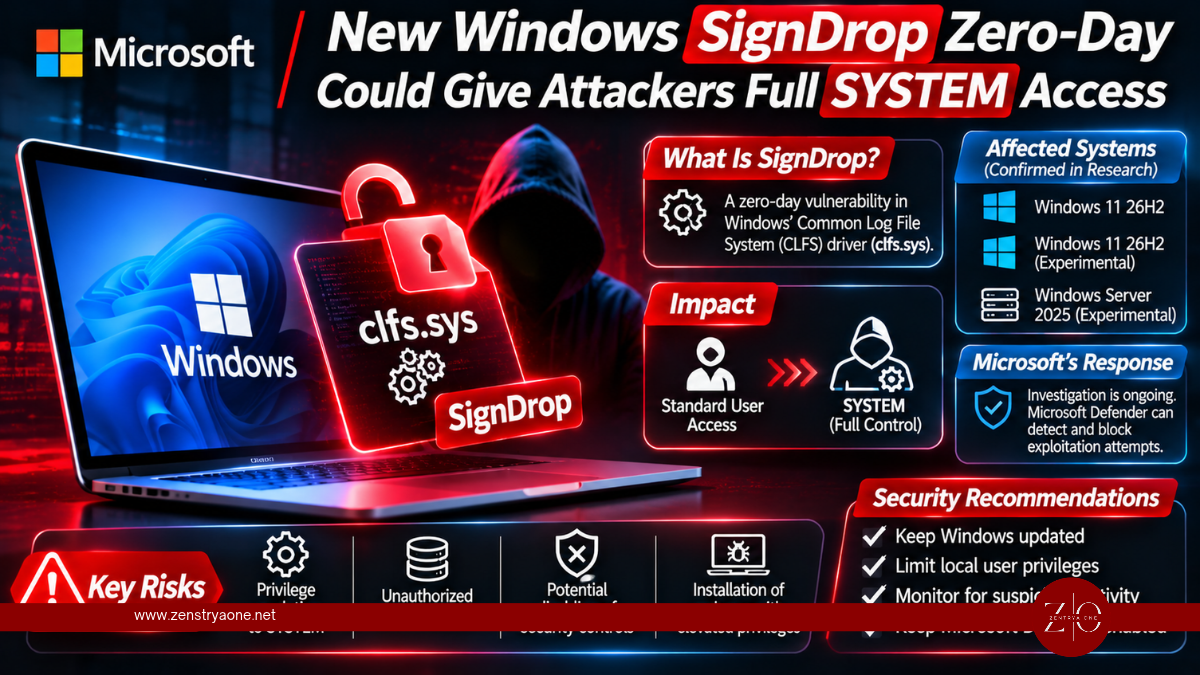
A newly disclosed Windows zero-day vulnerability, named SignDrop, could allow attackers with ordinary user privileges to gain full SYSTEM-level access by exploiting a security feature within Microsoft's Common Log File System (CLFS).
The exploit was publicly released on November 10, 2026, by security researcher Abdelhamid Naceri, also known as Nightmare Eclipse or MSNightmare.
The discovery is particularly concerning because it targets a protection mechanism Microsoft introduced to prevent earlier attacks against the CLFS driver.
How Does SignDrop Work?
The vulnerability affects the Windows CLFS driver, clfs.sys, which manages logging operations for Windows applications and system components.
In October 2025, Microsoft introduced a security mechanism that uses cryptographic authentication to prevent unauthorized modifications to CLFS log files.
However, SignDrop exploits the way this mechanism creates companion authentication files with the .cnpf extension.
An attacker with local user access can prepare a specially crafted log file and cause a privileged process, such as Microsoft Defender, to open it.
By manipulating file paths, the attacker can redirect file creation into a location under their control.
This can potentially allow the attacker to escalate privileges from a standard Windows account to NT AUTHORITY\SYSTEM, the operating system's highly privileged security context.
Which Windows Systems Are Affected?
The researcher demonstrated the exploit on several Windows configurations, including:
- Windows 11 26H2
- Windows 11 26H2 Experimental
- Windows Server 2025 Experimental
The attack depends on the CLFS authentication configuration.
Systems with authentication mode values of 0 or 1 are within the researcher's claimed vulnerable configurations.
Although the researcher suggested that a large proportion of Windows installations could be affected, independent testing indicates that exploitation depends on specific operating system versions and configurations.
The full number of vulnerable devices remains unknown.
Microsoft Investigating the Vulnerability
Microsoft has acknowledged the vulnerability report and confirmed that an investigation is underway.
As of November 14, 2026, the SignDrop vulnerability has not received an official CVE identifier or a dedicated security patch.
Microsoft also stated that its Defender security product can detect and block attempts to exploit the reported vulnerability.
Importantly, there is currently no confirmed evidence of SignDrop being exploited in real-world cyberattacks.
Independent security researchers have successfully reproduced the exploit under certain conditions, although its reliability varies.
Why Is This Vulnerability Dangerous?
If successfully exploited, SignDrop could allow an attacker who already has local access to a vulnerable computer to obtain elevated privileges.
This could potentially enable:
- Unauthorized modification of system configurations.
- Access to sensitive files and protected resources.
- Installation of malicious software with elevated permissions.
- Attempts to interfere with endpoint security controls.
- Further compromise of connected systems.
SignDrop is a local privilege escalation vulnerability, meaning it does not independently allow attackers to compromise a Windows computer remotely.
Security Recommendations
Until Microsoft releases further guidance or a security update, organizations should:
- Maintain Windows security updates: Install supported updates and monitor Microsoft's security advisories.
- Limit local user privileges: Avoid unnecessary administrative permissions.
- Monitor suspicious activity: Investigate unusual privilege escalation attempts and unexpected SYSTEM-level processes.
- Keep Microsoft Defender enabled: Maintain current antivirus signatures and endpoint protection.
- Review CLFS configurations: Identify potentially affected systems without disabling existing security protections.
- Strengthen endpoint monitoring: Use EDR solutions to detect suspicious file operations and abnormal system behavior.
Security teams should avoid disabling CLFS authentication as a workaround because doing so could expose systems to previously addressed vulnerabilities.
Security Takeaway
SignDrop demonstrates how a security mechanism designed to prevent exploitation can introduce unexpected weaknesses when interacting with privileged system processes.
Although no confirmed real-world attacks have been reported, the public availability of exploit code increases the importance of monitoring affected systems.
Organizations should maintain strong endpoint security, restrict unnecessary privileges and follow Microsoft's security guidance while awaiting further remediation.
Related reporting

Hackers Steal Over 1 Million Payment Card Records by Exploiting Old Windows Vulnerability
Hackers exploit Windows CVE-2024-49138 to compromise over 700 POS terminals across 20 countries, stealing more than one million payment card records.

Apple Fixes Critical iMessage Privacy Flaws That Could Expose Private Group Chats
Apple patches two iMessage vulnerabilities that could expose private group chats, alongside Bluetooth, AirPlay and Brotli security flaws.

Weekly Cybersecurity Recap: SSHole Attacks, Linux Root Exploits, AI-Powered Threats and Network Breaches
Weekly cybersecurity recap covering SSHole exploitation, Debian and Ubuntu APT vulnerabilities, Zyxel switch attacks, AI-driven threats and malware campaigns.