Sri Lanka Restricts Two EY Audit Partners Following Rs. 13.64 Billion NDB Bank Fraud
Sri Lanka's Central Bank restricts two EY audit partners following the Rs. 13.64 billion NDB fraud, raising concerns about banking controls and audit oversight.
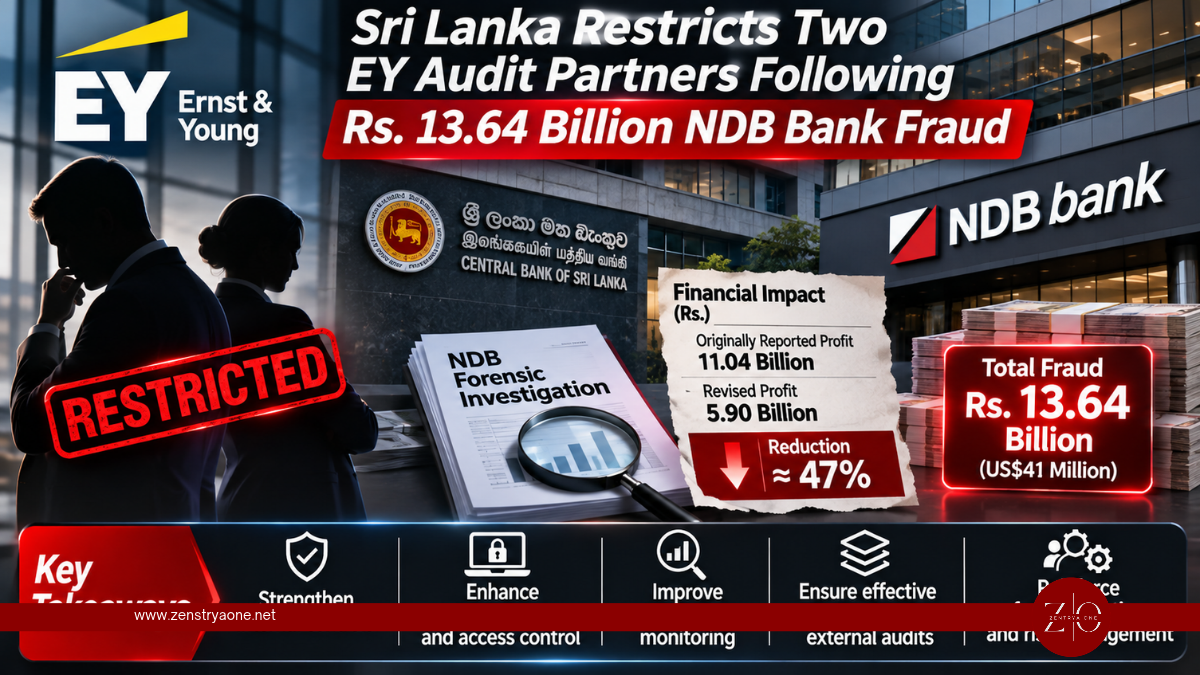
The Central Bank of Sri Lanka (CBSL) has restricted two Ernst & Young (EY) audit partners from conducting audits of licensed banks following the discovery of a major internal fraud at National Development Bank (NDB), valued at approximately Rs. 13.64 billion (US$41 million).
The decision has raised questions about financial oversight, internal controls and the effectiveness of external audits in detecting fraudulent banking transactions.
Central Bank Takes Action Against EY Auditors
On November 10, 2026, CBSL clarified that the engagement partner and engagement quality assurance partner involved in NDB's financial statement audits must not be assigned to future licensed-bank audit engagements.
However, EY itself remains an approved auditing firm and can continue auditing licensed banks in Sri Lanka.
The restrictions apply specifically to the two individuals involved in the NDB audit.
How the NDB Fraud Was Discovered
NDB initially disclosed suspicious financial activity on April 2, 2026, estimating the potential impact at Rs. 380 million.
Within days, the estimated amount increased to more than Rs. 13 billion.
A subsequent forensic investigation conducted by Deloitte Touche Tohmatsu India LLP established the total financial impact at approximately Rs. 13.64 billion.
The investigation identified weaknesses involving transaction monitoring, account reconciliation, user access management and internal governance.
The fraud allegedly involved employees working with external parties to divert money through the bank's electronic payment systems.
According to published reporting, unauthorized transfers were concealed using internal suspense accounts and questionable receivable balances.
NDB's Reported Profit Reduced by Nearly Half
EY issued an unmodified audit opinion on NDB's 2025 financial statements on February 25, 2026.
However, following the discovery of the fraud, NDB revised its reported after-tax profit for 2025.
Financial impact on 2025 reported profit:
| Financial indicator | Amount |
|---|---|
| Originally reported profit | Rs. 11.04 billion |
| Revised profit | Rs. 5.90 billion |
| Reduction | Approximately 47% |
The significant revision has prompted questions about whether the bank's financial reporting controls and audit procedures were sufficient to identify unusual transactions.
Investigation Raises IT Audit and Governance Concerns
The forensic findings highlighted several areas requiring stronger oversight, including:
- User access controls: Managing employee permissions to banking applications and financial systems.
- Transaction monitoring: Identifying unusual electronic fund transfers and suspicious transaction patterns.
- Account reconciliation: Detecting differences between actual balances and accounting records.
- Privileged access management: Restricting sensitive system functions to authorized personnel.
- Internal audit effectiveness: Ensuring control weaknesses are identified and escalated promptly.
These issues demonstrate the importance of combining financial auditing with effective information systems auditing and continuous security monitoring.
Regulatory Investigation Continues
Sri Lanka's Accounting and Auditing Standards Monitoring Board has also investigated EY's compliance with applicable auditing standards.
Its findings were referred to the Attorney General in October 2026 for advice on potential legal action.
The investigation's detailed findings have not been publicly released, and no final determination of audit negligence has been announced.
CBSL has also directed NDB to strengthen its internal controls, improve governance and implement corrective measures under regulatory supervision.
Security and Governance Takeaway
The NDB incident highlights the financial and operational consequences of weak internal controls and insufficient monitoring of sensitive banking transactions.
Banks and financial institutions should strengthen access management, transaction reconciliation, fraud detection, segregation of duties and independent audit oversight.
The case reinforces the importance of effective IT governance, risk-based auditing and continuous monitoring in protecting financial institutions from internal fraud.
Related reporting

Italy Fines Meta €805 Million Over Facebook's Unauthorized Access to Android Photo Galleries
Italy fines Meta €805 million for Facebook's Android photo gallery access without specific consent, affecting approximately 20 million users.

SilentAir Hackers Compromise Asian Telecom Networks to Intercept SMS Verification Codes
SilentAir hackers compromise Asian telecom networks to intercept SMS 2FA codes and spy on Taiwanese users, exposing mobile signaling security risks.

Global Microsoft Outage Disrupts Outlook, Teams and Microsoft 365 Services Worldwide
Global Microsoft outage disrupts Outlook, Teams, Microsoft 365 and Copilot worldwide, affecting businesses, governments and millions of users.