Russian Police Arrest Three Suspected VasyGrek Hackers and Shut Down Cybercrime Infrastructure
Russian police arrest three suspected VasyGrek hackers and dismantle cybercrime infrastructure linked to phishing, malware and financial theft.
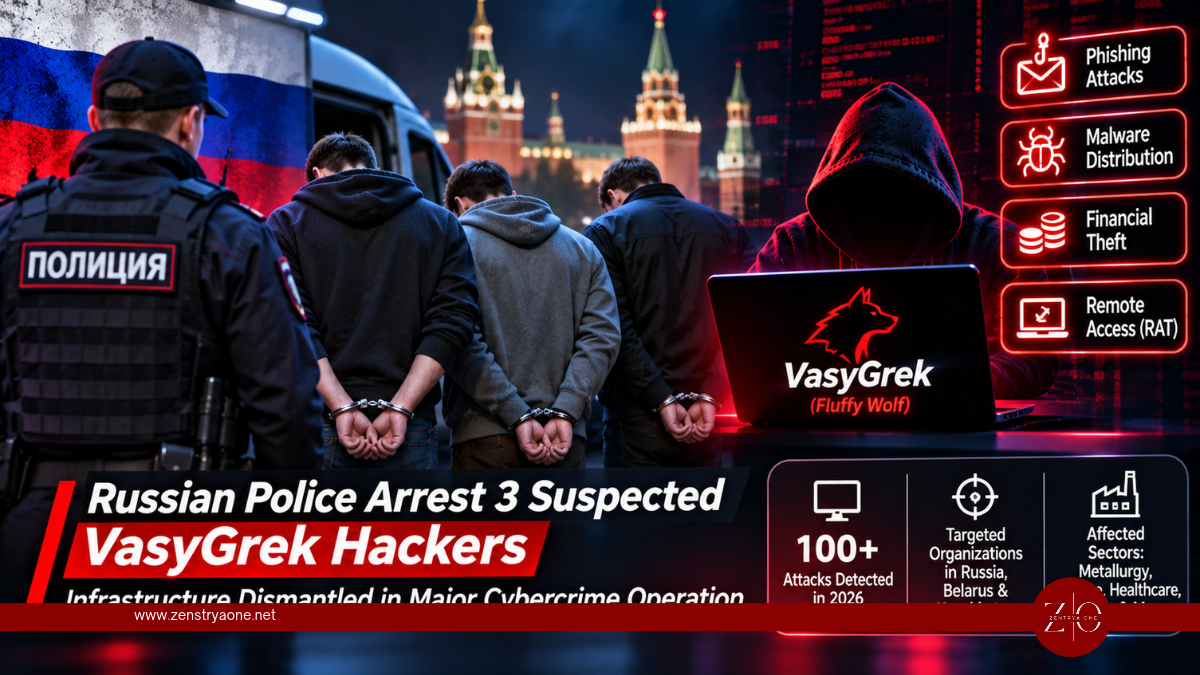
Russian authorities have arrested three suspected members of the cybercriminal group VasyGrek, also known as Fluffy Wolf, and dismantled infrastructure allegedly used to conduct phishing attacks, distribute malware and steal money from corporate bank accounts.
The law enforcement operation targeted a financially motivated hacking group that has reportedly operated since 2016, attacking businesses and government organizations across Russia and neighboring countries.
Three Suspects Detained in Cybercrime Investigation
Russia's Ministry of Internal Affairs (MVD) announced that investigators had identified three suspected members of VasyGrek following an investigation supported by cybersecurity company Kaspersky.
Authorities searched the suspects' homes and offices, confiscating computers, communication devices and other digital evidence.
According to Russian media reports, the suspected group leader was placed under house arrest, while two alleged accomplices were released under travel restrictions.
The suspects are accused of stealing organizational funds and developing, distributing or using malicious software.
If convicted, they could face significant prison sentences under Russian criminal law.
Phishing Attack Led to $8,000 Theft
Investigators highlighted a September 2025 incident in which attackers allegedly compromised an organization's accounting department.
The attackers sent an employee a fraudulent email disguised as legitimate business correspondence. The message included a malicious attachment presented as a financial reconciliation document.
When the employee opened the file, malware reportedly allowed the attackers to remotely access the computer and the company's online banking system.
The criminals subsequently transferred more than 660,000 Russian rubles, approximately $8,000, into accounts under their control.
Investigators said the group maintained phishing websites impersonating financial and accounting services and used foreign-hosted servers to support its operations.
More Than 100 Cyberattacks Detected in 2026
Kaspersky reported detecting more than 100 attempted attacks linked to VasyGrek between January and September 2026.
The activity primarily targeted organizations in:
- Russia
- Belarus
- Kazakhstan
The most frequently targeted industries included metallurgy, industrial supply chains and government services.
Additional targets operated in healthcare, finance, energy, agriculture, and oil and gas.
Researchers observed that the group's operations had expanded beyond its earlier focus on Russian organizations.
Malware and Remote Access Tools Used by VasyGrek
VasyGrek relied on phishing campaigns and multiple malware families to compromise corporate systems.
Security researchers identified tools including:
- MetaStealer and PureLogs Stealer: Used to collect sensitive information and credentials.
- PureCrypter: Used to deliver and conceal malicious payloads.
- WarZone RAT and PureRAT: Remote access trojans that allow attackers to control infected computers.
- XMRig: Cryptocurrency mining software that can be deployed on compromised systems.
- PowerLoader and BurnsRAT: Additional malware associated with the group's operations.
Researchers also identified attacks involving a Go-based backdoor capable of executing commands on infected devices.
The attackers reportedly used legitimate online services to host malicious components, making some activity more difficult to detect.
Security Recommendations for Organizations
The case demonstrates how financially motivated cybercriminals continue to exploit employee trust and weaknesses in corporate email security.
Organizations should prioritize the following precautions:
- Strengthen email security: Deploy phishing protection, attachment scanning and malicious URL detection.
- Train employees: Educate finance and accounting teams about fraudulent invoices and reconciliation documents.
- Secure financial transactions: Require independent verification and dual authorization for high-value transfers.
- Deploy endpoint protection: Monitor suspicious processes, credential theft and unauthorized remote access.
- Enforce multifactor authentication: Protect corporate accounts and financial applications with strong authentication.
- Monitor network activity: Investigate unusual outbound connections and unauthorized remote administration tools.
Security Takeaway
The arrest of three suspected VasyGrek members represents a significant law enforcement action against a long-running cybercriminal operation.
However, the case also highlights the continuing effectiveness of phishing, malware and credential theft against corporate financial systems.
Although Russian authorities say the group's infrastructure has been dismantled, it remains unclear whether the arrests will permanently end its activities.
Organizations should strengthen financial transaction controls, employee awareness and endpoint monitoring to reduce the risk of similar cyberattacks.
Related reporting

Italy Fines Meta €805 Million Over Facebook's Unauthorized Access to Android Photo Galleries
Italy fines Meta €805 million for Facebook's Android photo gallery access without specific consent, affecting approximately 20 million users.

SilentAir Hackers Compromise Asian Telecom Networks to Intercept SMS Verification Codes
SilentAir hackers compromise Asian telecom networks to intercept SMS 2FA codes and spy on Taiwanese users, exposing mobile signaling security risks.

Sri Lanka Restricts Two EY Audit Partners Following Rs. 13.64 Billion NDB Bank Fraud
Sri Lanka's Central Bank restricts two EY audit partners following the Rs. 13.64 billion NDB fraud, raising concerns about banking controls and audit oversight.