China-Linked Hackers Exploit Sogou Software Flaw to Deploy DarkVigil Malware Across Asia
China-linked hackers exploit a Sogou Input Method vulnerability to deploy DarkVigil malware, targeting users and organizations across Asia, including Sri Lanka.

Cybersecurity researchers have uncovered a sophisticated cyber espionage campaign in which China-aligned hackers exploited insecure communications in the popular Sogou Input Method software to deploy a surveillance backdoor known as DarkVigil.
The operation, attributed to a threat group tracked as SlippyNunchucks, targeted Chinese-speaking individuals and organizations across multiple countries, including Sri Lanka, Hong Kong, Thailand, Japan, Vietnam and Oman.
Security company ESET discovered that attackers manipulated Domain Name System (DNS) responses to redirect legitimate application traffic toward malicious servers.
How Hackers Exploited Sogou Input Method
Sogou Input Method is a widely used Chinese-language typing application owned by Tencent.
According to ESET, the attackers exploited a weakness in the application's branded vocabulary promotion feature, which retrieved configuration information through unencrypted HTTP connections.
By manipulating DNS responses, the hackers redirected requests intended for legitimate Sogou infrastructure to attacker-controlled servers.
These servers returned malicious configurations that instructed the application to download additional files.
The attack relied on a legitimate Sogou component, SGTool.exe, to retrieve and execute the malicious payloads.
Researchers identified two important files used in the infection process:
- biz_helper.exe: A legitimate Adobe executable abused during malware execution.
- libcef.dll: A malicious DLL containing the DarkVigil backdoor.
This technique, known as DLL sideloading, allowed attackers to execute malicious code through legitimate software components.
DarkVigil Backdoor Enables Cyber Espionage
DarkVigil, also known as FDMTP, is a modular malware framework developed using .NET technologies.
The malware supports more than 20 plugins and communicates with attacker-controlled infrastructure using the Duplex Message Transport Protocol (DMTP).
These capabilities can enable attackers to maintain access to compromised systems, execute additional modules and collect sensitive information.
Researchers believe the malware is primarily used for surveillance and intelligence-gathering operations.
Sri Lankan Organizations Among Targets
ESET identified suspicious activity affecting organizations and individuals across several Asian countries.
One significant target was an organization operating Chinese-language online betting platforms in Sri Lanka, Hong Kong and the Philippines.
Researchers suggested that the targeting may be connected to China's restrictions on gambling activities involving Chinese citizens.
However, ESET has not publicly established the precise number of victims or confirmed that every targeted organization experienced a successful compromise.
Tencent Releases Security Update
Following responsible disclosure, Tencent addressed the vulnerability, tracked as CVE-2026-120422, in Sogou Input Method version 16.10, released in late October 2026.
The update replaces affected HTTP communications with encrypted HTTPS connections and introduces certificate pinning to strengthen communication security.
ESET also identified additional areas for improvement, including stronger file-type validation and restrictions on downloaded file locations.
The exact method attackers used to manipulate victims' DNS responses remains unknown.
Security Recommendations
Organizations and individuals using Sogou Input Method should take the following precautions:
- Update immediately: Install Sogou Input Method version 16.10 or later.
- Monitor DNS activity: Investigate unexpected DNS responses and connections to suspicious infrastructure.
- Strengthen endpoint protection: Detect malicious DLL loading and unauthorized executable activity.
- Restrict software privileges: Limit unnecessary administrative access and application execution permissions.
- Review network security: Protect routers, DNS settings and remote network infrastructure from unauthorized changes.
- Investigate suspected infections: Check affected endpoints for DarkVigil indicators and unusual outbound communications.
Security Takeaway
The SlippyNunchucks campaign demonstrates how attackers can weaponize legitimate software features to distribute advanced surveillance malware.
Rather than relying exclusively on traditional phishing or malicious downloads, the attackers manipulated trusted application traffic to compromise targeted systems.
The incident highlights the importance of encrypted application communications, secure DNS infrastructure, endpoint monitoring and timely software updates in defending against sophisticated cyber espionage campaigns.
Related reporting

Hackers Steal Over 1 Million Payment Card Records by Exploiting Old Windows Vulnerability
Hackers exploit Windows CVE-2024-49138 to compromise over 700 POS terminals across 20 countries, stealing more than one million payment card records.
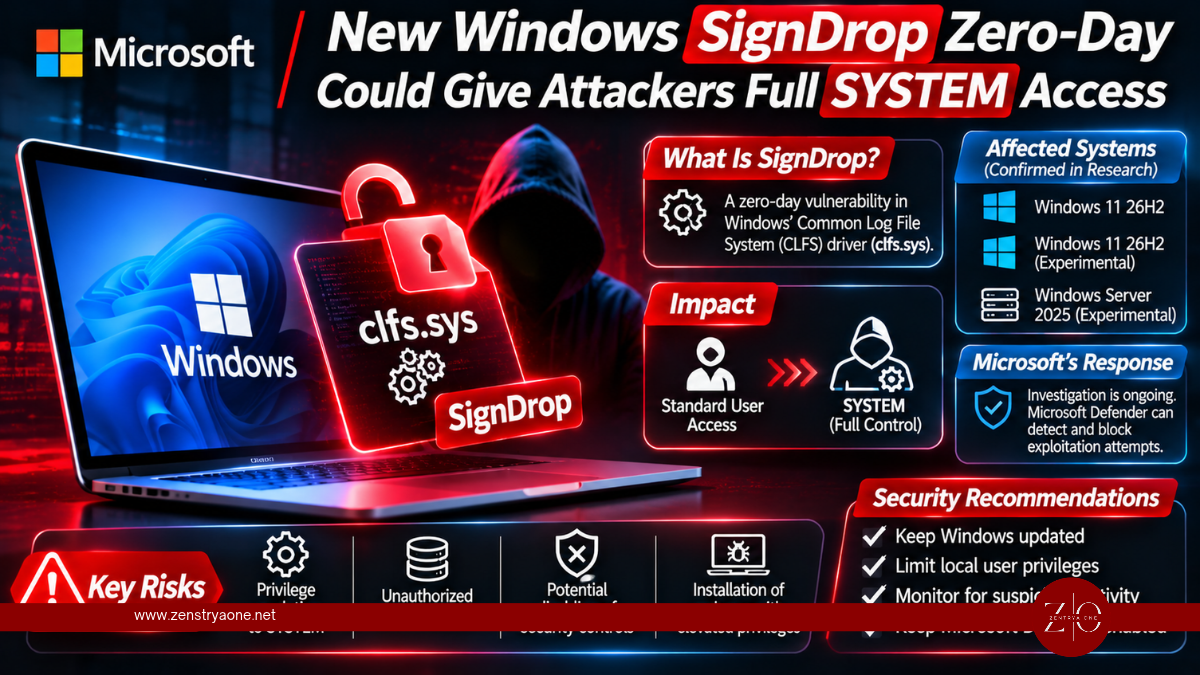
New Windows SignDrop Zero-Day Exploit Could Give Attackers Full SYSTEM Access
New Windows SignDrop zero-day exploit abuses Microsoft CLFS security protections to gain SYSTEM privileges. Learn about affected systems and mitigation.

Apple Fixes Critical iMessage Privacy Flaws That Could Expose Private Group Chats
Apple patches two iMessage vulnerabilities that could expose private group chats, alongside Bluetooth, AirPlay and Brotli security flaws.